
Searching the San Juan County Court Docket
Start a San Juan County court docket search at Utah Courts Xchange. Court staff enter district and justice case data into CORIS. Xchange picks it up from there. Pick your court level first. Then narrow the scope to San Juan County or a specific local court. A citation or case number helps. The same number can turn up in more than one Utah court, so pair it with the location. For a name search, give the exact last name, the first name, and a case type, plus a date range if you know one.
- Read the citation or filing and note the full court name.
- Select District Court, Justice Court, or both in Xchange.
- Enter the case number, citation number, or a narrow party-name search.
- Open the case history and read its events in date order.
- Check the separate court calendar for a current hearing.
- Ask the correct clerk for a certified copy or missing public document.
Xchange is not always free. Searching and pulling documents can carry a charge, and the posted fee page and the registration screen have shown different search prices. Check the current price before you pay for a search.
San Juan Court-Level Map
Jurisdiction splits the San Juan County court docket. Seventh District Court handles felonies, Class A misdemeanors, and ordinary civil matters. Most Class B and C misdemeanors, infractions, traffic tickets, ordinance cases, and small claims belong to the justice courts in their own territory. Juvenile Court sits apart, with restricted access.
| Court | Typical docket | Starting point |
|---|---|---|
| San Juan District | Felony, Class A, civil | Xchange district scope |
| San Juan County Justice | County limited matters | County justice route |
| Monticello City Justice | City limited matters | Shared clerk route |
| Blanding City Justice | City limited matters | Blanding court route |
| Juvenile Court | Juvenile matters | Restricted process |
The Seventh Judicial District page identifies the official district resources.
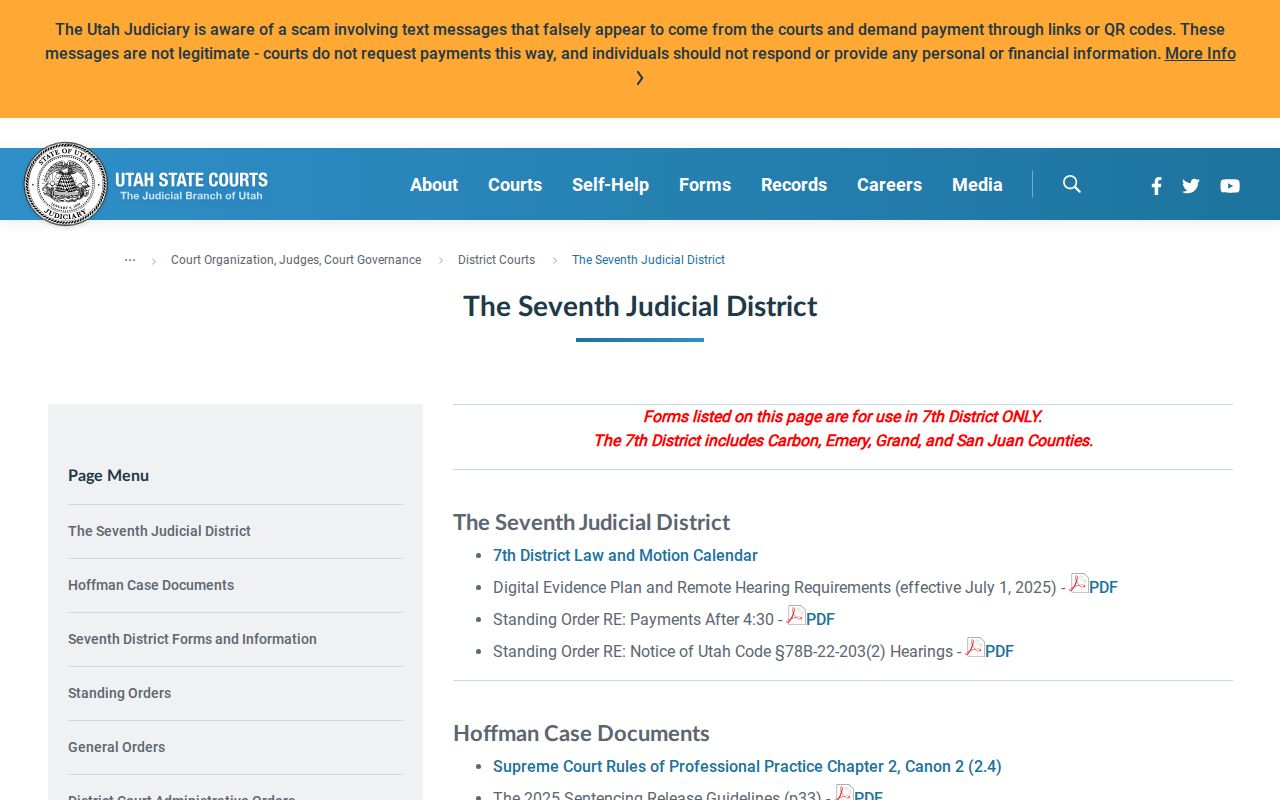
This official view sorts the district route out cleanly, so four-county figures never get mistaken for San Juan totals.
Inside a San Juan County Court Docket
Xchange calls a docket a case history. It is an index in time order rather than the whole file. Expect the court, location, case type, and number; the filing date; party roles and attorneys; charges, proceedings, motions, and hearings; plus orders, disposition, judgment, and account events. Read it with care. A charge is not a conviction. A hearing listed on the docket is no proof it ever took place.
| Heading | Court, location, type, number, and filing date. |
|---|---|
| Parties | Public roles and attorney fields when available. |
| Proceedings | Filings, motions, settings, minutes, and rulings. |
| Outcome | Plea, disposition, judgment, dismissal, or satisfaction. |
| Account | Financial entries, not a certified payoff quote. |
A paid document link is its own thing. Even when one filing is private or exists only on paper, the public history can stay visible.
San Juan County Xchange Fields
Jurisdiction chooses district, justice, or both, while Search Type separates all cases from judgments entered. Search Scope runs statewide, countywide, or court-specific, and Citation Location helps tell local venues apart. Date panels narrow filing, disposition, judgment, or satisfaction dates. Codes give a first clue to what you are looking at. FS marks a felony category. MD and MO cover misdemeanor groups. Traffic choices include TN, TC, PN, and PC. A small-claims trial de novo can show up in district court as ST. Confirm every code against the live list.
Courts That Keep Dockets in San Juan County
For official confirmation of local court locations, turn to the state directory. It lists district, juvenile, and justice functions in Monticello, with Blanding identified separately. The directory page shows each court's contact details for San Juan County.
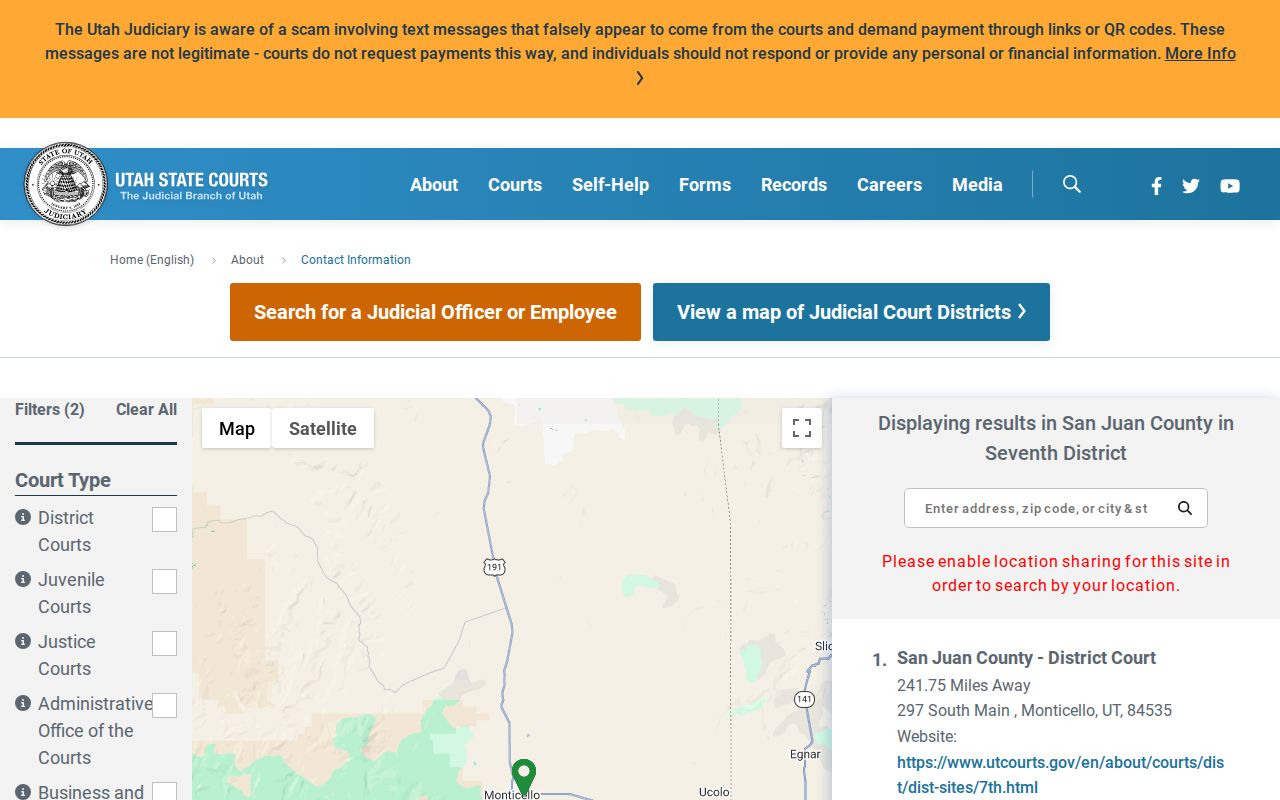
The directory also blocks a common error: the county Clerk/Auditor keeps county-government records, not judicial court dockets.
Monticello’s Shared Court Address
Several San Juan County court functions route through 297 South Main in Monticello. District, juvenile, county justice, and Monticello city justice work out of that shared spot. They do not share one docket. Let the case caption or citation decide which clerk and which search scope apply. Call 435-587-2122 for district and juvenile matters. County and Monticello justice questions go to 435-587-2544 or jcsanjuan@utcourts.gov. Give the complete court name when you contact staff. Monticello's city Administration Building at 17 N 100 E is a different address. It is not the listed justice-court address.
How to Find Court Dates and Settings
Utah Court Calendars is a separate tool from Xchange. It searches by case, party, judge, attorney, bar number, date, and location. The official calendar refreshes weekdays at 5:30 a.m. Choose Monticello District, Blanding Justice, or San Juan County Justice as fits your case. The state calendar is the scheduling route. That official page shows upcoming settings by court and date.
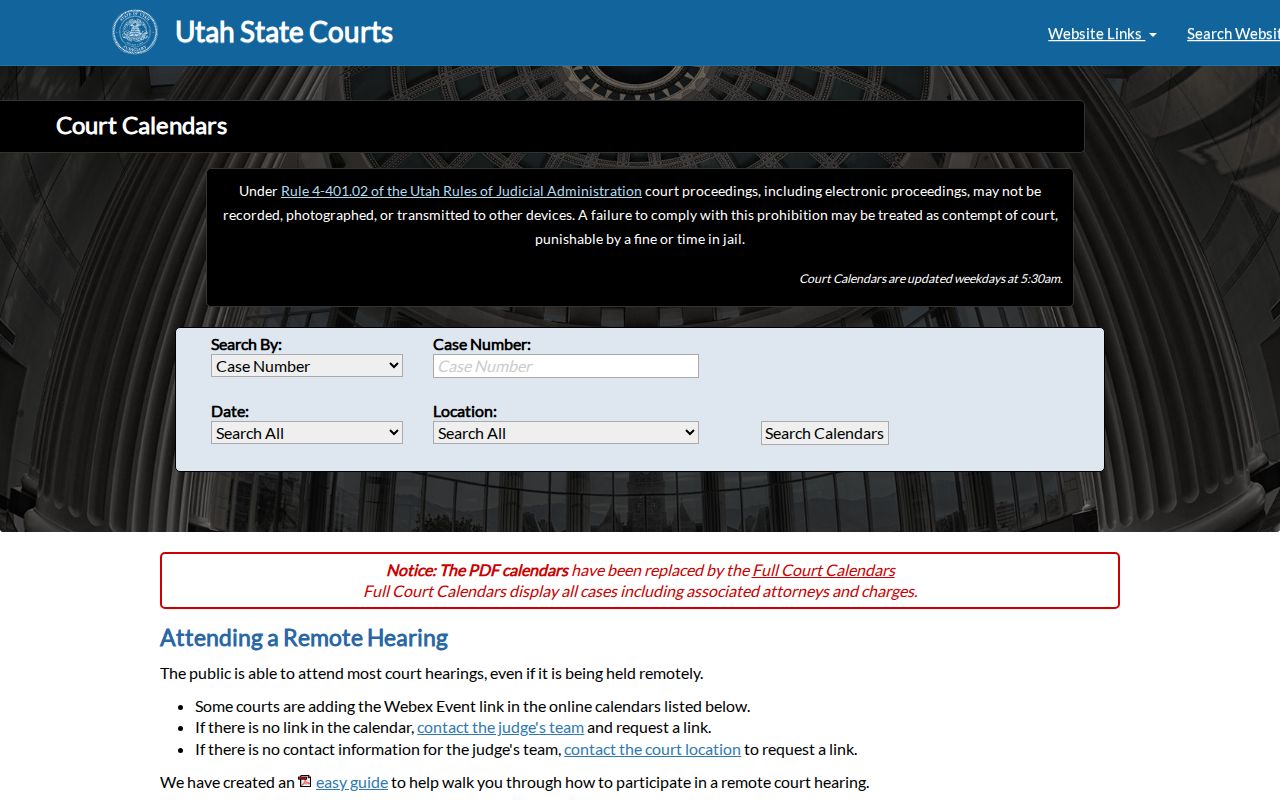
When a calendar conflicts with older history, call the named court before you travel or join online. San Juan County court dates walks through the full setting workflow.
Blanding’s Monday Docket Route
Blanding City Justice Court sits at 167 E 500 N, Blanding, Utah 84511. Office hours run 8 to 11 a.m. Monday through Thursday, Friday hours vary, and court happens Monday morning. The phone line is 435-678-2334 extension 3, and email is JCBLANDING@UTCOURTS.GOV. The city's local page links a calendar. It also links a secure payment search built on a court dropdown and a citation or case-number field. That tool is not the full case-history system. A missing payment result can mean several things. The wrong court may have been chosen. So could a filing delay, a manual citation, or simply no amount due.
Public Access to Court Dockets
Access follows Utah judicial rules 4-202.02 through 4-202.09, along with GRAMA. Public access does not open every filing. Sealed, expunged, juvenile, child-welfare, termination, and certain civil-family matters stay out of ordinary public Xchange results.
Classification comes first.
UCJA Rule 4-202.02 defines public, private, controlled, protected, safeguarded, sealed, and juvenile court-record classes.
UCJA Rule 4-202.03 permits access to public court records and limits access to sealed material.
UCJA Rule 4-202.04 sets the written request requirements and the route for challenging a denial.
Utah Code 63G-2-201 supplies the broader GRAMA right to inspect and copy public government records, subject to applicable limits and fees.
A missing result has many causes: the wrong court, old data, a private category, sealing, expungement, or juvenile status. A public judgment can exist even where the underlying papers are private. Getting nonpublic material requires authorized requests with the required proof and written process.
Docket Records at the Clerk's Office
The judicial clerk can route a request, explain plain versus certified copies, walk through filing procedure, and fix an Xchange data problem. Staff cannot give legal advice. They cannot rule on a motion, promise a reset, or disclose restricted material without authority.
San Juan District Court Clerk
297 South Main
Monticello, Utah 84535
435-587-2122
District and juvenile court routing
Name the court and the record precisely. Say whether you need inspection, a plain copy, a certified copy, a recording, or a transcript. Justice matters belong with the clerk of that county or city court. That is not the district desk. Utah describes a usual ten-business-day response window. That window is not a guarantee, and fees may apply.
San Juan Remote Docket Access
A 2024 order allows access in several ways. Phone, email, video, appointment, scanner, secure drop box, and listed workstations all count. Sites include Blanding, Monticello, and Montezuma Creek. Contact the court at least one business day before you need a workstation. A workstation is not always a staffed counter. A remote hearing link does not grant recording rights either. The court calendar and the local order restrict recording or transmitting proceedings.
San Juan Courthouse Access Rules
Access to public records does not put every corner of a courthouse up for browsing. Utah Courts provides free public Xchange and CORIS terminals at most district courthouses, some justice locations, and the State Law Library. The San Juan pages make no promise here. They name no terminal room. They set no counter hours at the courthouse. So call the clerk first. Ask whether a terminal exists, whether an appointment is required, and which entrance or counter takes record requests.
Local rules also draw hard lines around recording. The order bars courtrooms, teleconference areas, clerk desks, staff workstations, juvenile probation, security screening, prisoner transport, and other restricted spaces. Hallway or lobby recording stays limited and still answers to the judge's order plus statewide rules. Never photograph a case screen showing private information. Ask the clerk or the public system for a copy instead of capturing a workstation display. Everyone entering District Court is subject to search.
San Juan Docket and Case File
A docket is only one layer of a court record. Xchange shows the case history. A linked PDF is just an electronic document in the file. A clerk's paper file may never reach the internet at all. Certified copies add authentication the docket lacks. Recordings and transcripts travel their own separate request paths.
- Case history
- The dated event index.
- Certified copy
- A clerk-authenticated record.
- Recording
- Court-held audio or video.
- Transcript
- A certified written rendering.
Older files: registers and docket books can move to Utah State Archives once the court's custody period ends.
San Juan Criminal and Civil Dockets
On a San Juan County criminal docket, a charge is not a plea. A plea is not a judgment. Keep those steps separate when you read entries. District court handles felonies and Class A matters, while lower offenses begin in the proper justice court. Juvenile delinquency is not an ordinary public result.
Civil district dockets gather contracts, torts, property, and general claims. Small claims start in justice court, though a trial de novo can grow into a district case. Domestic and guardianship categories may be private or only partly public.
San Juan Traffic Docket Choices
A San Juan County traffic citation could belong to several courts. Blanding City Justice Court, Monticello City Justice Court, San Juan County Justice Court, or another court printed on the ticket itself. Where you live does not pick the venue. Start with the court named on the citation, keep the citation number with the location, and use that court's clerk or payment route. Xchange carries the fuller public case history. The payment screen confirms only the transaction details it was built to show.
Paying and contesting are two different choices. Utah's traffic guidance lets a person pay an eligible fine or contest the citation in court. The stated response date still governs. Missing a response or a court date can bring further action and license consequences. If a deadline or hearing slips by, contact the named justice court at once. Deferred Traffic Prosecution has statewide eligibility rules, though San Juan's participation in the online dispute-resolution list is not confirmed. A local link alone never signals approval for a specific case.
San Juan County Court Dockets by City
The official 2020 Census list counts three incorporated places. Blanding has a named city court. Monticello shares contact and location clues with county functions. No current Bluff municipal justice court operates.
Blanding Docket Search
Use the local justice court, calendar, payment route, and Xchange.
Monticello Docket Search
Distinguish city justice, county justice, district, and juvenile records.
San Juan Docket Search Checks
Accuracy starts with keeping each identifier tied to its source court. Write down the court name, location, case type, and number. Note the date you checked. Read docket entries in order, and compare near-term settings with the calendar. If nothing matches, check the other court level only when jurisdiction is unclear. Ask about classification or old CORIS coverage.
- Use MyCourtCase for an authorized user’s own linked case.
- Use Xchange for public district and justice history.
- Use Court Calendars for current settings.
- Use the clerk for copies, recordings, and access decisions.
- Use the Clerk/Auditor only for county records.
That source-by-source habit keeps a payment result, a calendar listing, or a historical index from standing in for a full case file. Each one answers a different question.
San Juan Historical Docket Research
Modern Xchange coverage does not settle every older record question. District data is generally complete from the late 1990s, per Utah Courts. Justice-court history is another matter. Its conversion date and completeness vary. So an empty online docket search may simply mean an older pre-CORIS file. Ask the court clerk where the conversion point falls, what the old index looks like, and whether the material still sits at the courthouse.
The Utah State Archives court-record guide covers historical registers of actions, docket books, and case files. A register is a compact chronological summary. It reads much like a modern case history. Even so, it is not every document in the file. Records can transfer after a court custody period ends. For genealogy or local-history work, preserve the former court name, approximate date, parties, and case number. Then check both the judicial clerk and the matching archive series.
Map and Directions to the San Juan County Public Safety Building
Seventh District Court, which hears San Juan County's felony, Class A misdemeanor, and ordinary civil cases, is reached through the Public Safety Building at 297 South Main in Monticello. The same address also routes county Justice Court and Monticello City Justice Court contacts, though each keeps its own docket, so a caller should state the full court name before assuming one counter handles every matter. District and juvenile filings use the 435-587-2122 line.
Visitors entering District Court are subject to search, and the local recording order restricts devices and photography around entrances, clerk desks, security screening, and courtroom areas. No public parking inventory, transit route, or terminal-room detail is published for this address, so calling ahead to confirm terminal availability and the correct counter is the safer plan before a long trip.