
Searching San Juan County Criminal Dockets
Utah Courts Xchange Start with the court level. Felonies and Class A misdemeanors are filed in San Juan County District Court. Most Class B and C misdemeanors, infractions, and traffic matters start in San Juan County Justice Court, Monticello City Justice Court, or Blanding City Justice Court. Not sure of the level? Select both jurisdictions. A case number alone will not do the job. The same number can exist elsewhere in Utah, so pair it with San Juan County and the court location. Name queries work best when you type the exact last and first name. Then narrow the docket results by case type, court, or date. A wildcard helps with odd spellings. But a query that is too broad can hit the portal's result cap and run up needless search charges.
- Choose District Court, Justice Court, or both.
- Set the scope to San Juan County or the known local court.
- Enter the case number, or use exact party-name fields.
- Check the case-type code and filing date before opening a result.
- Read the case history in order, then request the source document when its exact terms matter.
The San Juan County case lookup walks through the name and number fields in more depth. For a hearing that is coming up soon, check the court calendar too, since it is separate from the case history.
San Juan Criminal Docket Codes
The codes on a San Juan County criminal docket search come straight from the Xchange case-type list. That live list always controls, because codes can change. Three criminal codes come up often and help you spot the venue and case type. None of them tells you the final result.
- FS
- State felony, which starts in District Court.
- MD
- Misdemeanor DUI, read with the court location and full history.
- MO
- Other misdemeanor, which still requires a venue check.
- Disposition
- The recorded outcome event, distinct from the charge and plea.
Utah's case-code reference lists the official categories behind every public docket search, including the criminal codes that matter in San Juan County.
The official code reference shows the full list straight from the courts.
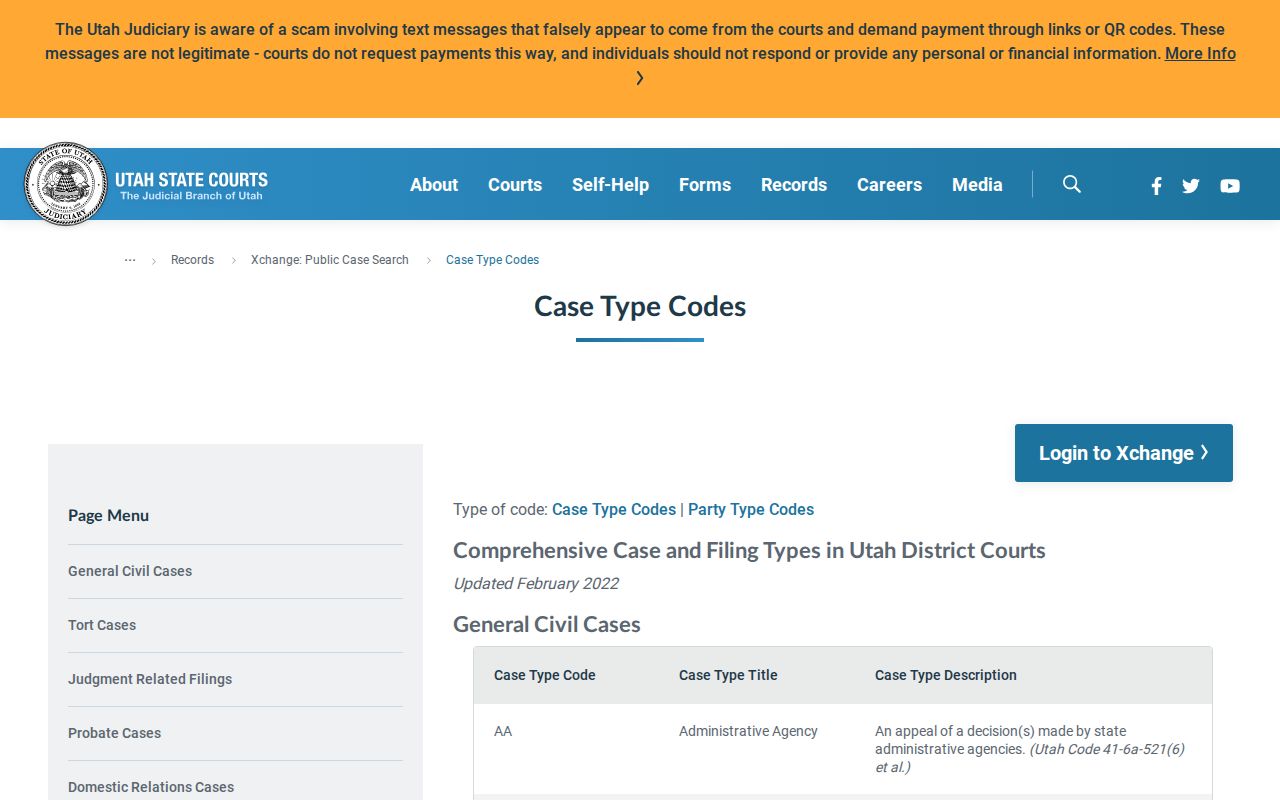
Treat the capture as a starting aid only. Before you read a San Juan County result, check the current live code table.
Inside a San Juan County Criminal Docket
Utah names the detailed public register "Case History" or "Extended Case History." Think of it as the docket sheet. A San Juan County criminal docket can show the court, location, case type, case number, filing date, current judge, attorneys, charge data, hearings, motions, plea and disposition entries, judgment activity, and an account summary. Links to electronic documents sit apart from the history line itself. Short court records are common here.
| Court and location | Distinguishes San Juan District Court from each county or city justice venue. |
|---|---|
| Charge and level | States the filed allegation and classification, not a finding of guilt. |
| Proceedings | Lists arraignments, motions, pretrial settings, pleas, trials, sentencing, and later events. |
| Plea and disposition | Must be read as separate, chronological entries with the judgment. |
| Account summary | Shows financial fields, but is not certified proof of a judgment or balance. |
Dates can trip you up. The filing date and the violation date may differ, and the judge field changes with new assignments. When you take notes from a San Juan County criminal docket, copy the words and dates exactly.
Four San Juan Criminal Docket Lines
Charge, plea, disposition, and judgment are four different things. The charge shows what was filed, and the plea is the defendant's response. A disposition entry records an outcome event. The judgment, by contrast, holds the court's entered ruling and any terms it ordered. So never use one line to guess at the other three.
| Entry | What it answers | What it does not prove |
|---|---|---|
| Charge | What allegation and level were filed | A conviction or final outcome |
| Plea | How the defendant responded at that point | The final judgment by itself |
| Disposition | How an issue or case was resolved | Every term in the signed order |
| Judgment | The court's entered decision | That no later event occurred |
A warrant or failure-to-appear line is itself a docket event, not a status report. Confirm current status with the court or with counsel before drawing conclusions from an old entry.
How a Criminal Case Moves
Staff build a San Juan County criminal docket one event at a time. The typical path is simple to describe, but real cases can loop through repeated settings, extra motions, amended charges, or later financial entries. The chronology always controls.
Docket flow: Filing › Arraignment › Pretrial › Plea or Trial › Disposition › Sentencing
The Seventh District posts a San Juan County Criminal Motion form with a case caption, case number, a block for the requested order and its reason, a prosecutor-response block, and a judge-order block. Per the Seventh Judicial District page, its plea statement and certificate are required for every felony and Class A misdemeanor plea. Remember that a filed form is just one docket event, not the final outcome. A setting can move. Check the current calendar and court contact before you travel or log in remotely.
San Juan Settings Versus Case History
Xchange and the Utah Court Calendars do different jobs. Xchange carries the longer San Juan County criminal case history. The calendar is the live scheduling layer, searchable by case, party, judge, attorney, date, or location. Updates land on weekdays at 5:30 a.m.
| Need | Best starting point |
|---|---|
| Filed charges, pleas, motions, and outcomes | Xchange case history |
| Current hearing date or location | Utah Court Calendars and the judge team |
| Exact order or certified judgment | Document link or clerk record request |
Do the calendar and the case history clash? Call the clerk for that court. San Juan County's remote-availability order covers phone, email, video, appointment, drop-box, and remote-workstation access, but the court itself sets the current hearing method.
Courts That Hold Criminal Dockets
Criminal jurisdiction in San Juan County is split. The Seventh District Court takes felonies and Class A misdemeanors. San Juan County, Monticello City, and Blanding City Justice Courts each handle the limited-jurisdiction matters tied to their own territory. Juvenile delinquency lives in a separate, restricted court record.
| Venue | Criminal docket role | Search route |
|---|---|---|
| San Juan County District Court | Felonies and Class A misdemeanors | Xchange, District Court scope |
| County and city justice courts | Most Class B/C misdemeanors and infractions | Xchange, correct Justice Court location |
| Juvenile Court | Juvenile matters under restricted access | Authorized court route, not ordinary public search |
The San Juan County Attorney prosecutes in district, justice, and juvenile courts. That broad role does not change each court's jurisdiction, and it does not put every case on the same docket path.
San Juan Criminal Search Controls
The search screen offers several ways to trim a San Juan County criminal docket search. The Xchange Help page walks through each control. Jurisdiction and scope come first, since they frame every query. From there you can filter in several ways. Case number, last name or company, first name, case type, dates, citation number, and citation location are all options. The help page itself shows the search layout. No private San Juan County case gets exposed along the way.
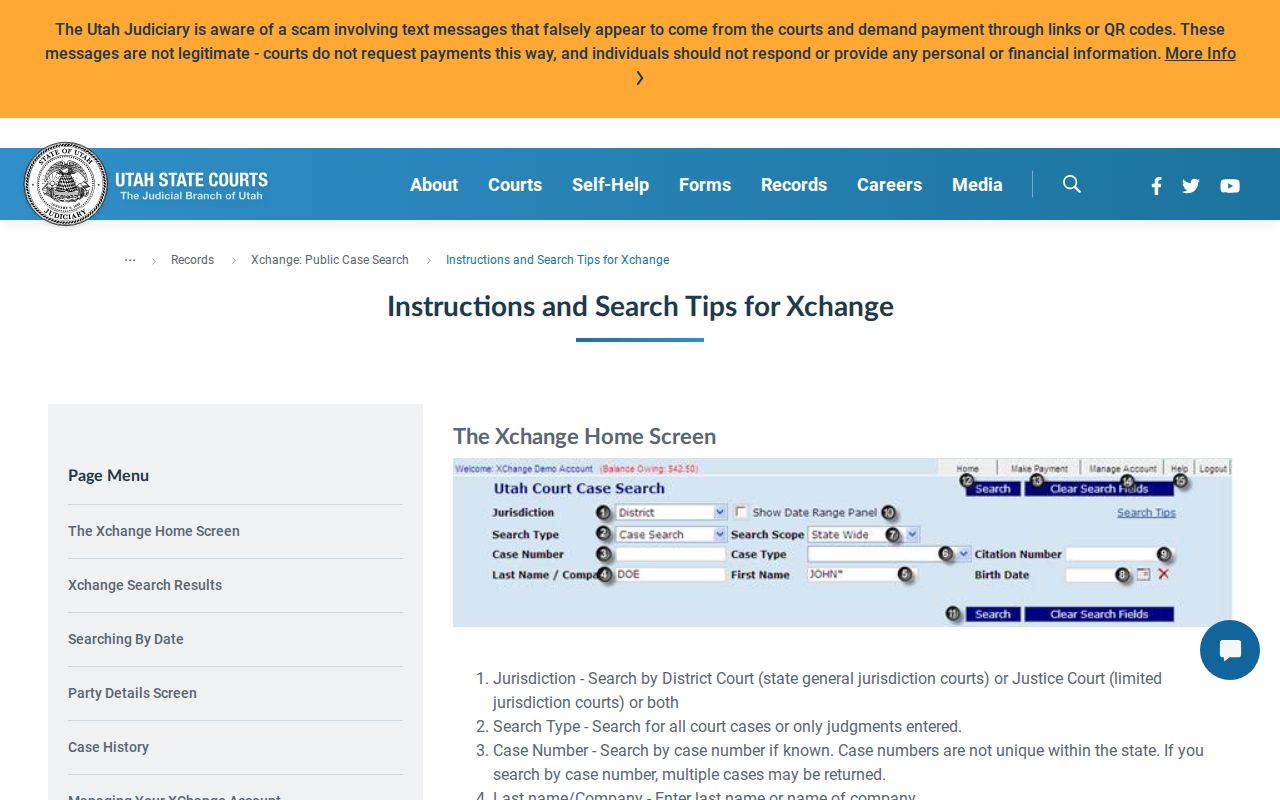
Keep your first query tight. Every search costs money, and results are capped. A broad sweep of the San Juan County criminal docket wastes fees fast. Two official screens listed different search prices. Confirm the live charge before you submit anything. If Xchange comes up empty or will not load, the clerk of court is your next stop. Call or visit. Staff can point you to the right path, whether that is an inspection at the counter, a mailed request, copies, or a historical docket search. Parties and authorized users have one more option: MyCourtCase. It lets them view their own case documents and file eligible electronic papers. It is not the general public search, though.
Missing San Juan Criminal Results
An empty result screen proves nothing. A San Juan County criminal docket can sit outside ordinary public view for several reasons. It may be juvenile, sealed, expunged, or private. It might fall outside the relevant CORIS history. Or the case may have been filed under a different court location. Before you assume no case exists, double-check the court level. Also check the spelling of the name. Then hold onto the case number you have. Ask the clerk which lawful request route fits your situation.
Key point: Search both district and justice jurisdictions when the offense level is unclear, then confirm restricted or historical status with the clerk.
Documents filed electronically since July 1, 2010 are generally viewable when they are public and stored that way. That rule has limits, though. A history line, a PDF document, a transcript, an audio record, and a certified copy are all different products, and not every filing downloads.
Sealed Dockets and Public Access
Utah's court-record rules control who may see a San Juan County criminal docket. UCJA Rule 4-202.02 sorts records into classes. These include public, private, protected, safeguarded, sealed, and juvenile. A companion rule, UCJA Rule 4-202.03, opens public court records to view. It places strict limits on sealed ones. Keep one caution in mind. A public criminal history does not make every item tied to it public.
Access routes:
UCJA Rule 4-202.04 sets the written-request and challenge process.
Utah Code 63G-2-201 supplies the general public-record inspection framework, subject to court classification.
Put your request in writing. Name the court and describe the record with enough detail for staff to locate it. Delivery options are flexible. You can use the accepted electronic route, the clerk counter, mail, or another channel the clerk directs. Utah Courts says staff usually respond within 10 business days. Treat that as an expectation, not a promise of same-day access to a sealed docket.