
Getting San Juan County Court Records
Find the right court first. The San Juan County District Court clerk keeps Seventh District civil, felony, and Class A misdemeanor files. The San Juan County and Monticello City Justice Court clerk route handles its limited-jurisdiction cases. Blanding City Justice Court has its own clerk contact. Juvenile Court sits apart, with strict access limits. The county Clerk/Auditor keeps county-government records, not judicial case files.
Utah Courts Xchange is the statewide public case-history source for district and justice courts. Free public Xchange or CORIS terminals sit in most district courthouses and some justice locations. The Utah court-record request process covers inspection, copies, electronic material, and recordings. Once you confirm delivery instructions, you can call the proper clerk, visit the counter, or send the written form by mail or an approved electronic route.
- Identify the court, case number, parties, and approximate filing date.
- Check Xchange for a public history or available electronic document.
- Describe the exact order, judgment, filing, recording, transcript, or certified copy needed.
- Confirm the clerk's current in-person, mail, email, or drop-box instructions before sending the request.
- Ask about access status, format, fees, and certification before payment.
San Juan Court Request Form
The blank Utah Judiciary Request for Record form wants more than a case name. You describe the item with reasonable specificity and choose inspection or copies. There are fields for a fee-waiver basis and expedited treatment. A further field covers the legal basis for nonpublic material. Name, mailing address, daytime phone, date, and signature finish it off.
Use that judiciary form for a court file. San Juan County's general request form routes county business. The online Justice Court Plea Form answers a citation. Neither replaces the court-record request form. Precision pays. A request naming one signed judgment and its filing date works far better than a plea for every document tied to a person. That detail helps the clerk locate the right San Juan County record. It also lets the clerk estimate the cost.
San Juan County Court Record Types
Think of a court docket as the chronological index. The file behind it can include electronic documents and paper or scanned records. It may also hold authenticated copies and media from a hearing. Utah State Archives may hold much older registers of actions and docket books. That transfer happens once the court's custody period ends. Who holds the record changes with the product you want.
- Case-history summaries showing events, settings, and outcomes
- Public pleadings, motions, orders, judgments, and decrees
- Certified or exemplified copies authenticated by the clerk
- Digital audio or video requested through judicial services
- Transcripts produced through the judiciary transcript process
- Historical docket books and files held by Utah State Archives
A digital recording is not a transcript. Utah Courts sends recording requests to judicial-services staff at the court where the hearing happened. A transcript takes a separate path: request, assignment, payment, certification, then delivery.
San Juan Record Products Compared
Pick the least complex product that meets your real need. An Xchange history works for locating an event. A public PDF may carry the filed text, while formal proof often requires clerk certification.
| Product | What it provides | Request route |
|---|---|---|
| Case history | Chronological docket events and public case data | Xchange or courthouse terminal |
| Electronic document | A public filed PDF or scan, when available | Xchange document link |
| Court file | Public paper or scanned material not online | Correct court clerk |
| Certified copy | Clerk-authenticated court record | Clerk request |
| Recording | Digital audio or video, not written text | Judicial services |
| Transcript | Certified written rendering of a proceeding | Judiciary transcript process |
Inside a San Juan Court Record
The public history and the full case file overlap, but they are not identical. Xchange shows the court, location, case type, filing date, parties, proceedings, judgment or disposition, and account information. An electronic document link is a separate matter. It may be missing because the item is private, sealed, old, or not stored electronically.
| Case identity | Court, location, type, number, and filing date |
|---|---|
| Party roles | Plaintiff, defendant, petitioner, respondent, or other role where public |
| Proceedings | Hearings, minute entries, motions, pleas, rulings, and later events |
| Filed documents | Public pleadings, orders, judgments, and attachments when electronically available |
| Outcome | Disposition, judgment, sentence, satisfaction, or other final entry |
| Financial data | Public account entries and due dates, subject to clerk verification |
Read docket entries in date order. One charge, filing, or motion is not the final result. For a broader name or number lookup before ordering a file, try the San Juan County Case Lookup.
San Juan Clerk Contact Split
Three clerk routes matter for San Juan County records. State and local directories place District and Juvenile Court at 297 South Main in Monticello. That office is reachable at 435-587-2122. The county and Monticello justice route uses 435-587-2544 and jcsanjuan@utcourts.gov. Blanding Justice Court answers at 435-678-2334 extension 3 and JCBLANDING@UTCOURTS.GOV.
County and Monticello Justice Court
297 South Main, PO Box 833
Monticello, UT 84535
435-587-2544
Blanding City Justice Court
167 East 500 North
Blanding, UT 84511
435-678-2334 ext. 3
Say which court is involved when you call. A shared Monticello contact does not make a county case and a city case the same record.
Fees and Certified Copies
A plain printout of a San Juan County court docket can help you follow the case history, but it carries no clerk authentication. Some offices will not accept one. Check with the receiving office before you order anything. Utah's current fee page lists certified copies at $4 per document plus $0.50 per page, while exemplified copies run $6 per document plus $0.50 per page, since exemplification adds a higher form of authentication.
| Item | Posted amount or rule |
|---|---|
| Paper copy | $0.25 per sheet |
| Certified copy | $4 per document plus $0.50 per page |
| Exemplified copy | $6 per document plus $0.50 per page |
| Xchange document | $1 per document; verify current rate |
| Fax or email | $5 for 10 pages or less, then $0.50 per page |
| Actual mailing cost | |
| Staff time | Role-based rates apply after 15 minutes |
The official request page also lists $15 per unit for electronic storage other than hearings and $15 per half-day for audio or video. Fees can change. When staff time or other costs apply, the clerk arranges payment, so verify the total before relying on an estimate.
San Juan Record Response Window
Utah Courts states that a response is generally due within ten business days. That clock starts after a request is received. It is a response window only. It does not promise all copies by the tenth day. A large search, archive retrieval, access review, or payment arrangement may affect delivery.
Practical point: Keep the submitted form and any clerk reply. If the request is denied, the written response helps preserve the review route under Utah court rules.
Sealed Records and Public Access
Utah sorts court records into several classes. Public, private, controlled, protected, safeguarded, sealed, and juvenile files each carry their own access rule. Xchange leaves out sealed and expunged cases. Juvenile delinquency matters, child welfare cases, terminations of parental rights, and certain private civil categories are also excluded from its listings. A private case can still show a public hearing, judgment, order, decree, or limited history when its classification allows that much.
A blank search result proves nothing. The gap might come from classification, a pre-CORIS case, slow entry, or the wrong court. Ask the San Juan County clerk to confirm the status and what authorization you need. Staff cannot read restricted contents over the phone.
Key Utah rules:
UCJA Rule 4-202.02 defines court-record classifications.
UCJA Rule 4-202.03 governs public access and sealed-record limits.
UCJA Rule 4-202.04 sets written-request, authorization, and challenge procedures.
UCJA Rule 4-202.09 addresses certified copies and redaction duties.
GRAMA, found in Utah Code Title 63G, Chapter 2, covers many government records. Court files, though, answer to judiciary classifications and UCJA procedures instead. For any San Juan County court record, the originating clerk has the final word.
San Juan Court Record Screens
Utah's own pages separate the how-to from the costs. The Utah Courts request instructions walk through seeking inspection, copies, electronic material, and hearing media.
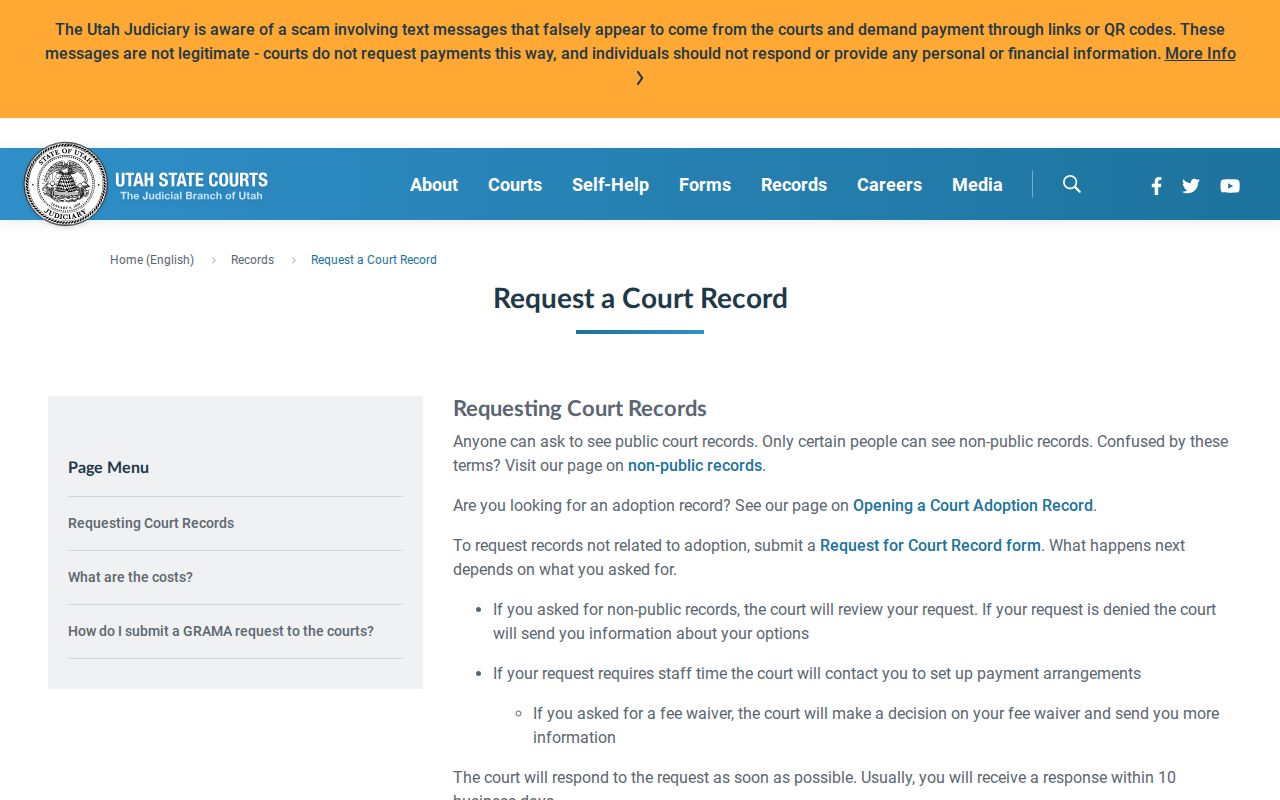
Those official instructions stress two things: describe the record precisely, and send the request to the right court. That pairing matters for any San Juan County court record request.
Before you pay for pages or order an authenticated copy, check the judiciary's current filing and copy-fee page.
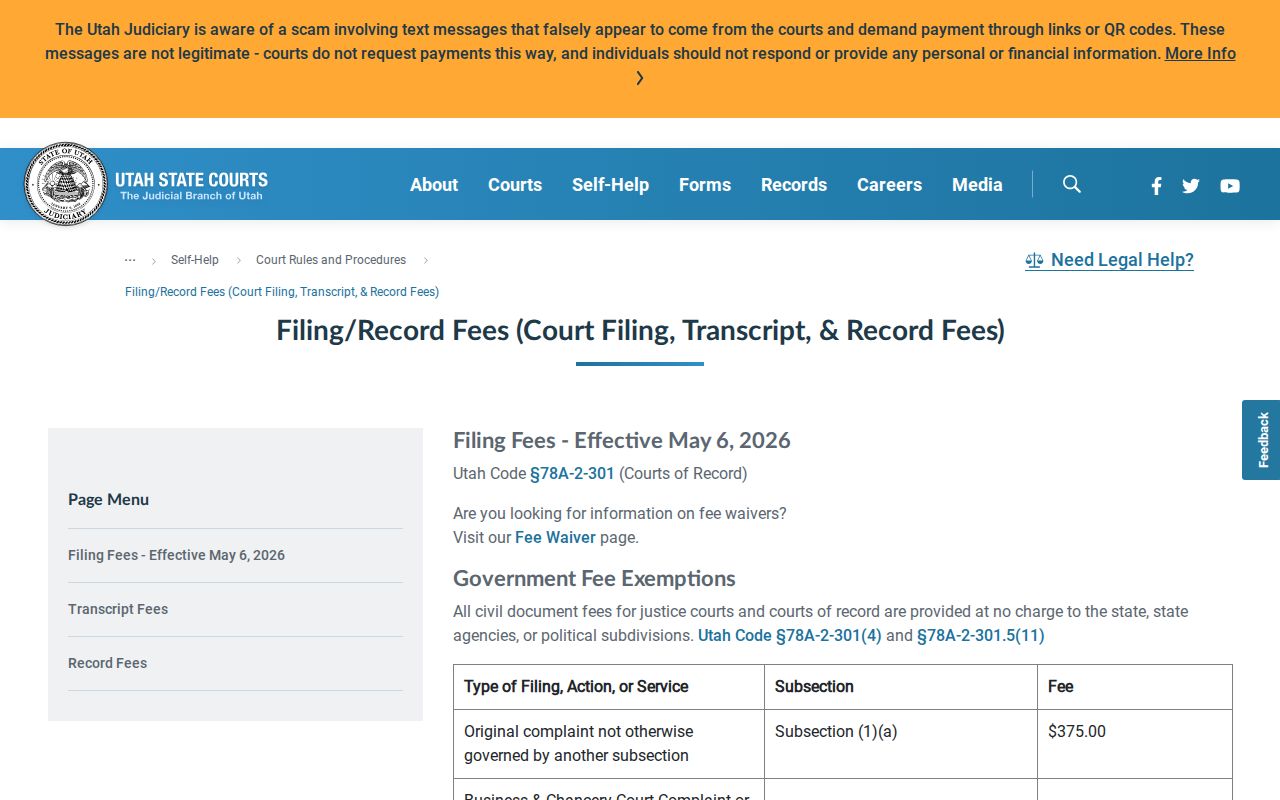
The posted fee schedule applies statewide. It prices the plain, certified, and exemplified San Juan County court record products described above.