
Searching San Juan County Civil Dockets
Utah Courts Xchange is the statewide home for public case information. It covers both district and justice courts. You can reach it through Utah Courts Xchange. For ordinary contracts, torts, property disputes, and other general civil claims, pick District Court. Then narrow the scope to San Juan County. Small claims work differently. Select Justice Court and choose San Juan County, Monticello City, or Blanding City to match where the case was filed.
A case number is the strongest search key. Pair it with the court, though, since numbers are not unique statewide. With a party name, use the exact last name or business name. Then add court, case type, and date filters. Xchange charges per search, so tighten the query before you submit it.
- Select District Court or the right Justice Court jurisdiction.
- Enter the case number and San Juan County court scope.
- If the number is unknown, search the exact party or company name.
- Compare the case type, filing date, and court before opening the result.
- Read the full history, then identify the exact complaint, order, judgment, or other document needed.
- Ask the clerk for a certified copy when formal proof is required.
Parties and authorized users get their own view. MyCourtCase lets them open their own files and submit eligible documents. It is not the general public civil docket search.
Choose the San Juan Civil Court
Pick the court before typing a name. Scope decides what comes back. San Juan County District Court serves as the general civil venue. Local justice courts take small claims inside their own territory. Appeals sit apart entirely. They carry a separate number and a separate search at the Utah Court of Appeals or Utah Supreme Court.
| Civil matter | Starting court | Search clue |
|---|---|---|
| Contract, tort, property, general civil | San Juan County District Court | District Court scope and civil type |
| Small claim | County or city Justice Court | Correct territorial court |
| Small-claims trial de novo | District Court | ST code and a separate district number |
| Appeal | Utah appellate court | Separate appellate docket |
The split guards against a familiar dead end. An empty District Court result does not mean no small-claims case exists. Per the Xchange overview, every Utah small claim has lived in justice-court CORIS since 2009.
Inside a San Juan County Civil Docket
In Xchange, a San Juan County civil docket appears as "Case History" or "Extended Case History." Expect the court, the case number and type, and the filing date. Parties and attorneys appear too. So does a chronological run of proceedings, filed documents, hearings, motions, orders, judgments, and financial entries. Treat it all as a finding aid. An entry saying an order was filed is not the order's text.
| Court and case type | Identifies the venue and civil category. |
|---|---|
| Parties and attorneys | Shows public roles and representatives when available. |
| Proceedings | Lists hearings, motions, minute entries, and due dates in order. |
| Orders and judgments | Records filing or entry activity; the source PDF may be separate. |
| Account entries | Shows amounts due or paid, but not certified judgment text. |
A hearing or judgment can be public while a pleading or attachment stays private. Case history and case documents are two layers, not one.
San Juan Civil Docket Codes
A civil code is a fast hint at what a San Juan County case involves. Codes shift over time, so treat the official Xchange case-type table as the governing list. Before you trust a code, weigh the court, the party roles, and the whole docket sequence around it.
- CN
- Contract matters in District Court when the code applies.
- TA
- Automobile tort matters.
- DA
- Divorce or related domestic matters, which may have private records.
- CS
- Custody or support matters subject to classification limits.
- GU
- Guardianship matters, where protected information requires care.
- ST
- Small-claims trial de novo in District Court, not the original justice filing.
When an ST matter follows a justice-court small claim, save both identifiers. The later district review never replaces the original local docket.
Civil Case Types on the Docket
A San Juan County civil docket holds more than a complaint and a judgment. District Court takes contracts, automobile and property torts, general claims, domestic relations, custody and support, guardianship, and similar district-jurisdiction matters. The local small-claims route runs through the justice courts.
- Contract and debt claims
- Automobile, property, and other tort matters
- General civil and real-property disputes
- Divorce and domestic-relations matters where public
- Custody, support, guardianship, and conservatorship matters subject to access rules
- Small claims and later trial-de-novo cases
Case type also controls access. Utah marks certain domestic and family records as private or partly private, even when a linked judgment entry stays public. So a missing document is never proof the case itself is absent.
San Juan Small Claims Dockets
Small claims open in the justice court with territorial authority. San Juan County and Monticello City share one official justice-court contact route, while the Blanding City Justice Court posts its own page. A search limited to Monticello District Court can miss the original limited-jurisdiction record.
| Record layer | What to preserve | Why |
|---|---|---|
| Original small claim | Justice court and case number | It contains the first filing and local history. |
| Trial de novo | District court number and ST code | It is a new district record tied to the appeal path. |
| Certified judgment | Clerk-issued copy | An Xchange screen print is not certified. |
One 2026 Blanding City Council monthly report listed zero small-claims matters in the months reported. That is a dated snapshot. It does not prove Blanding never takes a small claim.
Civil Docket Settings and Hearings
A San Juan County civil docket may show hearing dates, motion settings, due dates, minute entries, and orders. Those move a case along. Still, the case history is not the only current calendar. Cross-check any date through the Utah Court Calendars by case, party, judge, attorney, location, or date. That calendar refreshes on weekdays at 5:30 a.m.
A continuance or reset simply moves an event. It does not dismiss the claim. One scheduling order can also set several deadlines that sit beside the hearing entries. If the calendar and the docket seem to disagree, call the clerk or judge team before relying on either. The San Juan County court dates page walks through current-setting checks in more depth.
Note: A future docket entry can still change. Verify the time, place, and remote link close to the hearing.
Why San Juan Civil Pleadings May Not Download
Seeing a docket line does not promise a pleading will download. Classification and electronic availability are two separate things. A document can be public. Yet it may not be stored for online retrieval, and a public case can hold a private pleading or a safeguarded attachment. The official Xchange overview spells out the gap between case information and electronic documents. Its public repository overview appears below.
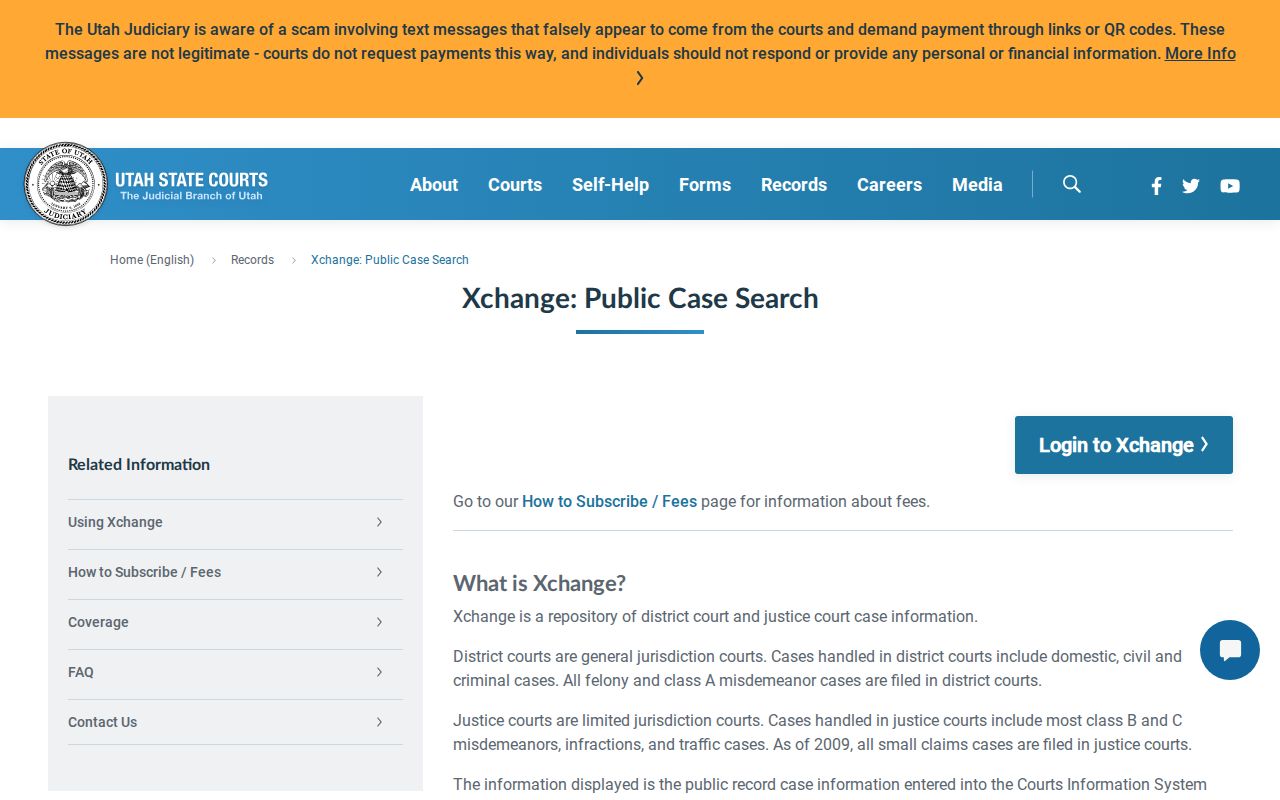
The repository tells you a case exists and traces its history. The clerk holds the actual San Juan County court records that never appear as online PDFs. Parties with their own filings can turn to MyCourtCase for authorized document access instead.
Certified San Juan Civil Judgments
A civil judgment only counts as certified when the court clerk authenticates it. An Xchange printout may sketch the case history nicely. Yet it is not a certified judgment on its own. When you send the Utah court-record request, name the court, the case number, and the document title. State the format you want too.
Fees come straight from the official judiciary schedule. Certified copies run $4 per document plus $0.50 per page. Exemplified copies run $6 per document plus $0.50 per page. Confirm the product and the total before you pay. Check the current Utah Courts fee schedule at its official source. That page is the official one.
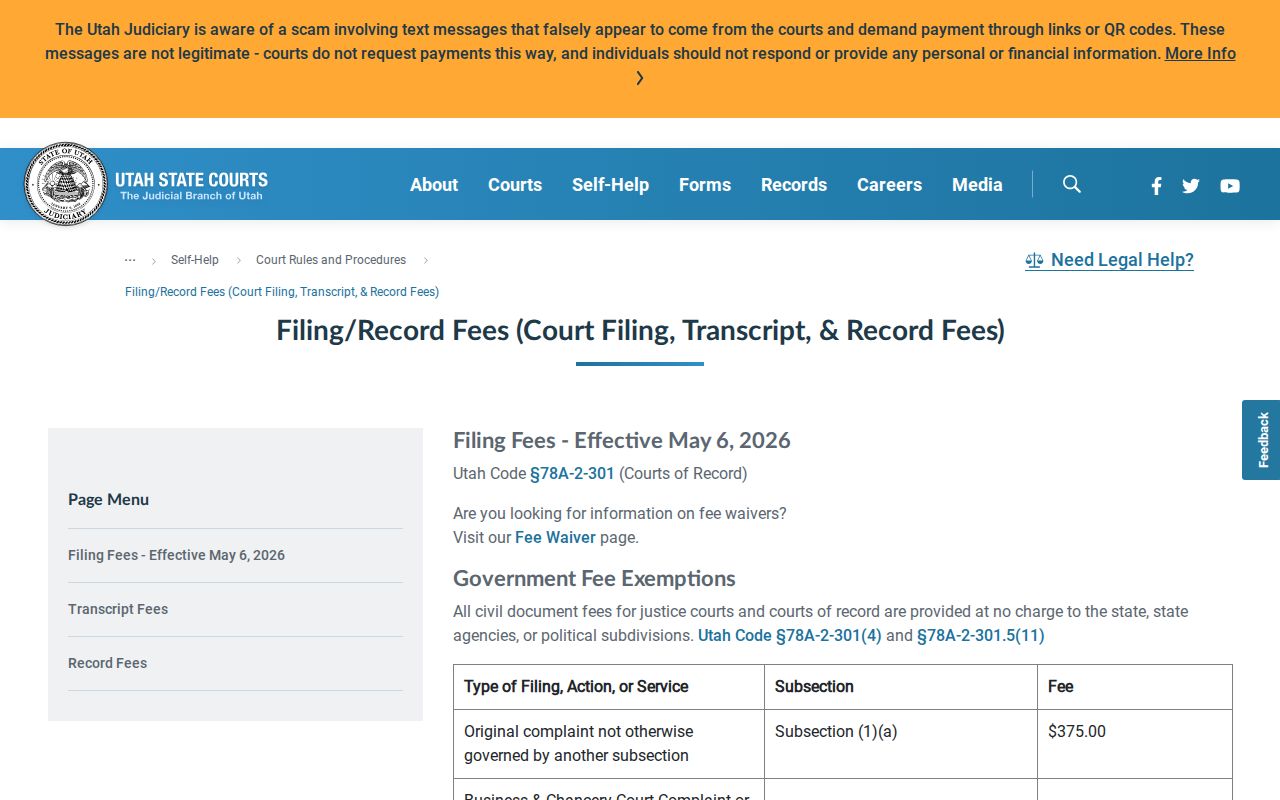
The live docket schedule controls whenever a saved copy and a later checkout disagree. Before you order, ask the receiving office which version it requires: a plain copy, a certified copy, or an exemplified one.
Civil Docket Access Rules
UCJA Rule 4-202.02 sorts Utah court records into classes. UCJA Rule 4-202.03 then opens public records to view while keeping sealed material closed. So a San Juan County civil docket can list a public judgment right beside a private family file.
Written request: UCJA Rule 4-202.04 calls for requester contact details and a reasonably specific record description. Authority and identification may be required for nonpublic access.
Utah Code 63G-2-201 provides the general GRAMA inspection framework, subject to court classification rules.
Start with Xchange. If no suitable PDF is there, send the written request form through the accepted electronic route, at the clerk counter, by mail, or as the clerk directs. The judiciary says staff usually respond within 10 business days. Expect added costs for copies, storage, staff time, delivery, and certification.
The official Xchange Help pages document each search control.
Review the official Xchange controls that the help page spells out.
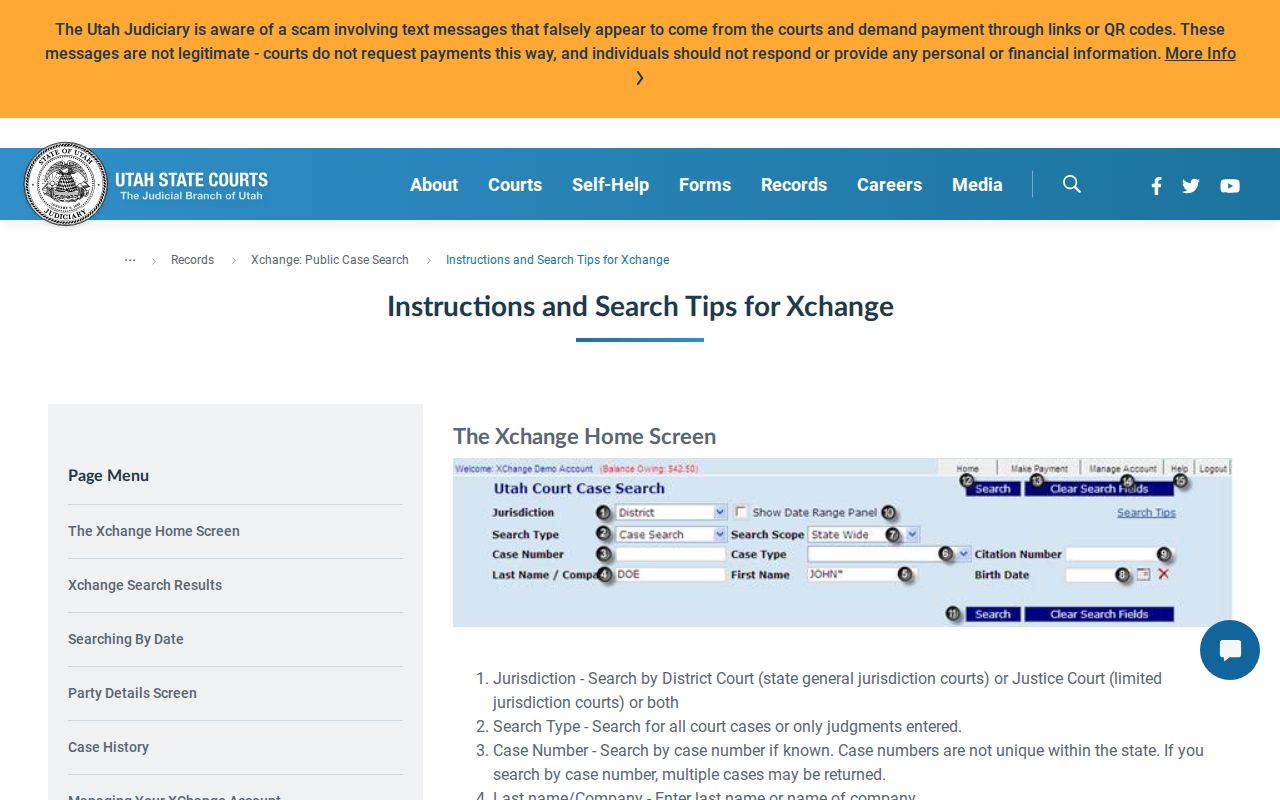
The search fields can surface a public case history. They cannot override private, protected, sealed, safeguarded, or juvenile classifications.